Consumer lending
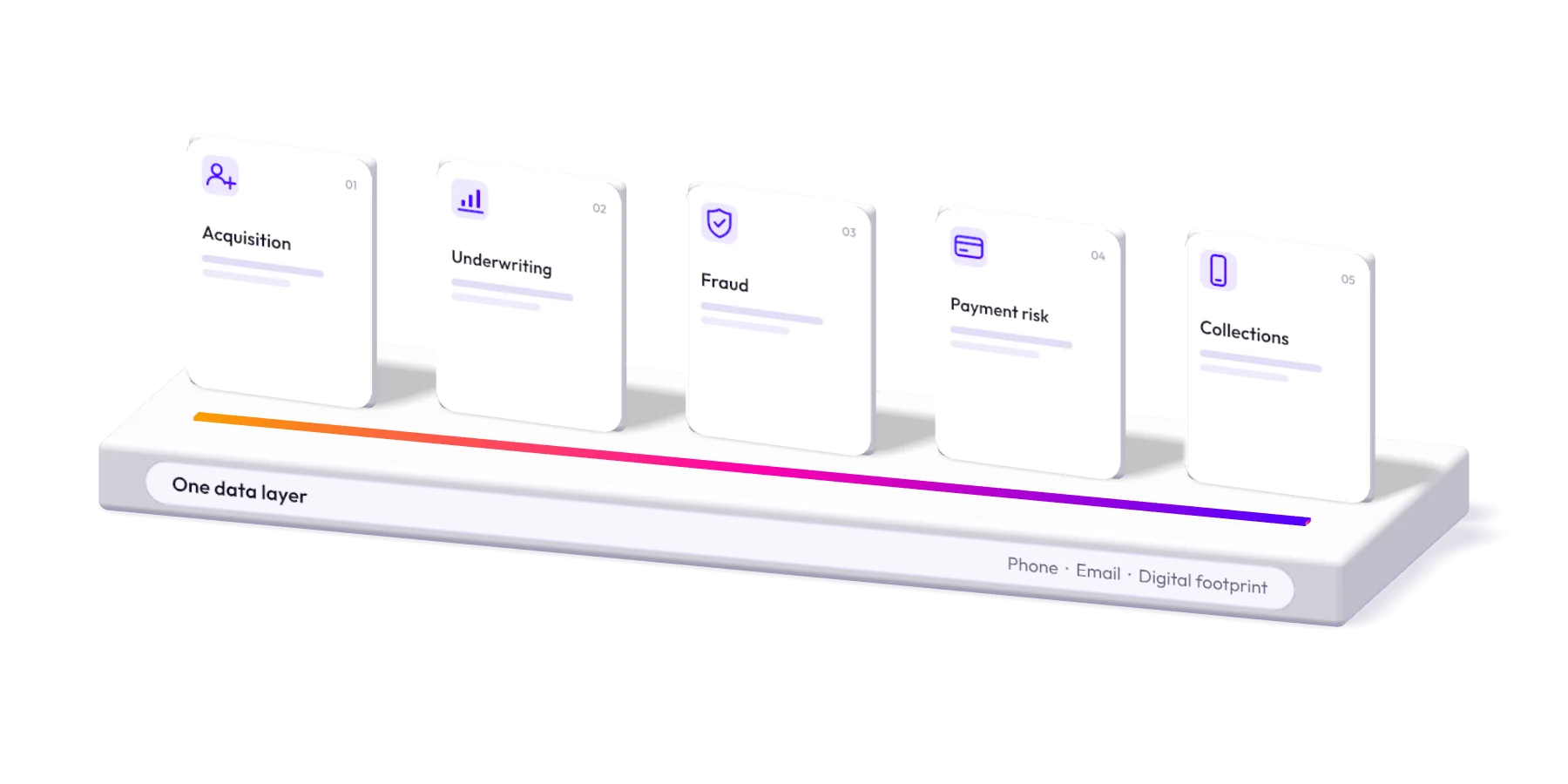
One data layer, five lending decisions
Why consumer lenders are still treating risk as separate projects.
A legacy credit score tells you who has a history. It doesn’t tell you who is safe to lend to.
In markets like Mexico, Brazil and the Philippines, that gap is where most lenders are losing growth, and where many are quietly absorbing fraud.
Consumer lenders in these markets tend to run approval, underwriting, fraud, payment risk and collections as separate workstreams, often with separate vendors and separate data. That structure made sense when each function had its own tools. It makes much less sense now, because all five decisions draw on the same underlying question: can we trust what we know about this person, and how has it behaved over time?
- 1AcquisitionCan we see this applicant?
- 2UnderwritingCan we tell good from bad?
- 3FraudReal identity, real intent?
- 4Payment riskIs anything changing?
- 5CollectionsCan we still reach them?
This article sets out how we think about each decision, and what the data shows.
1Acquisition: coverage decides who you can even evaluate
Before a lender can approve anyone, it has to be able to see them. Legacy credit scores cover only a fraction of the adult population in many emerging markets, and the people they miss are often the ones lenders most want to reach: younger customers, gig workers and first-time borrowers.
Alternative data (phone, email, digital footprint) gives you a way to evaluate those applicants. The question that matters is how much more of the population you can score.
Placeholder · Figure to add
Hit rate of Monnai data vs legacy credit scores in Mexico, Brazil and the Philippines, e.g., X% vs Y%.
A higher hit rate matters because every applicant you can’t score is one you either decline blindly or approve blindly. Both are expensive.
2Underwriting: coverage is only useful if it separates good from bad
More data is not the goal. Separation is.
When we test alternative data on top of an existing scorecard, we look at two things: Gini and KS lift, and the discrimination range across the score distribution.
Placeholder · Figure to add
Gini and KS impact from POCs, e.g., +X pts Gini on a thin-file segment; discrimination range from X to Y.
The practical point for risk teams is that alternative data is most valuable where legacy credit scores are weakest. On thick-file customers the lift is modest. On thin-file customers it can be the difference between a usable model and none at all.
3Fraud: three patterns, one signal source
Across the anonymized POCs we’ve run, including work with a global fintech and a major social platform, the fraud that shows up most often falls into three types:
- Synthetic and fabricated identities, where the person doesn’t exist or the details have been assembled.
- Account takeover, where a real identity is used by someone else.
- First-party fraud, where the applicant is real but has no intention of repaying.
Placeholder · Figure to add
Which fraud types were most common in which market, and what share was caught by phone, email and footprint signals that existing checks missed.
What these have in common is that they leave traces in the history of the phone number, email address and digital footprint: when it was created, where it has appeared, and how consistent it is. A document check can’t see any of that.
4Payment risk: the same signals, later in the relationship
Payment risk is often treated as a separate problem from onboarding. It shouldn’t be. A device-financing or buy now, pay later customer who passes onboarding can still show early warning signs: a change of phone number, a newly created email, activity that doesn’t match their history.
Monitoring those signals after approval lets lenders act before a missed payment, not after it.
5Collections: contactability is a risk signal
Collections performance depends heavily on whether you can reach the borrower. Knowing which phone numbers and emails are live and stable, and which are recycled or abandoned, lets collections teams prioritize accurately instead of working through lists.
Placeholder · Figure to add, if available
Uplift in contact rate or recovery from a customer example.
The case for one layer
A lender using the same data foundation across all five stages gets three advantages that separate vendors can’t provide:
- Consistency. The same identity is evaluated the same way at acquisition and at collections.
- Learning over time. Fraud caught at onboarding informs underwriting, and repayment behavior informs future approvals.
- Simpler operations. One integration and one data relationship instead of five.
What this looks like in practice
Placeholder · Customer story to add
An anonymized lender or fintech: its market, the problem it started with, what it deployed, and the result.
- The challenge The starting problem.
- The approach What they deployed.
- The outcomes Two or three measurable results, such as approval rate, fraud rate or Gini lift.