Credit and fraud
To a legacy credit score, a fraudster and a first-time borrower look the same
A legacy credit score cannot tell a fraudster from a first-time borrower. Both arrive with an empty file. In thin-file markets that is not an edge case, it is the default, and it turns fraud prevention and credit risk into one question.
TransUnion’s latest report puts US lender exposure to synthetic identity fraud at $2.4 billion and finds that 81% of suspected digital fraud happens at login or during a transaction, not at account opening.1 It reads as a fraud story. For lenders serving people with no credit history it is also a credit story, because the identity that fools you and the customer you wrongly turn away are the same blank record.
The blank record
At a global digital bank in Latin America, one in four applicants came back with no legacy credit score at all. For the rest of the thin-file segment the legacy credit score was barely more useful: it used only 215 points of its scale, and half of applicants sat within 29 points of each other. That is not a scoring flaw. It is what happens when there is no history to score.
An empty file forces a lender to guess two things at once. Is this a real person? And will they repay? A legacy credit score answers neither, so lenders improvise, usually by giving the first question to a fraud team and the second to a credit team.
Two stacks, two kinds of damage
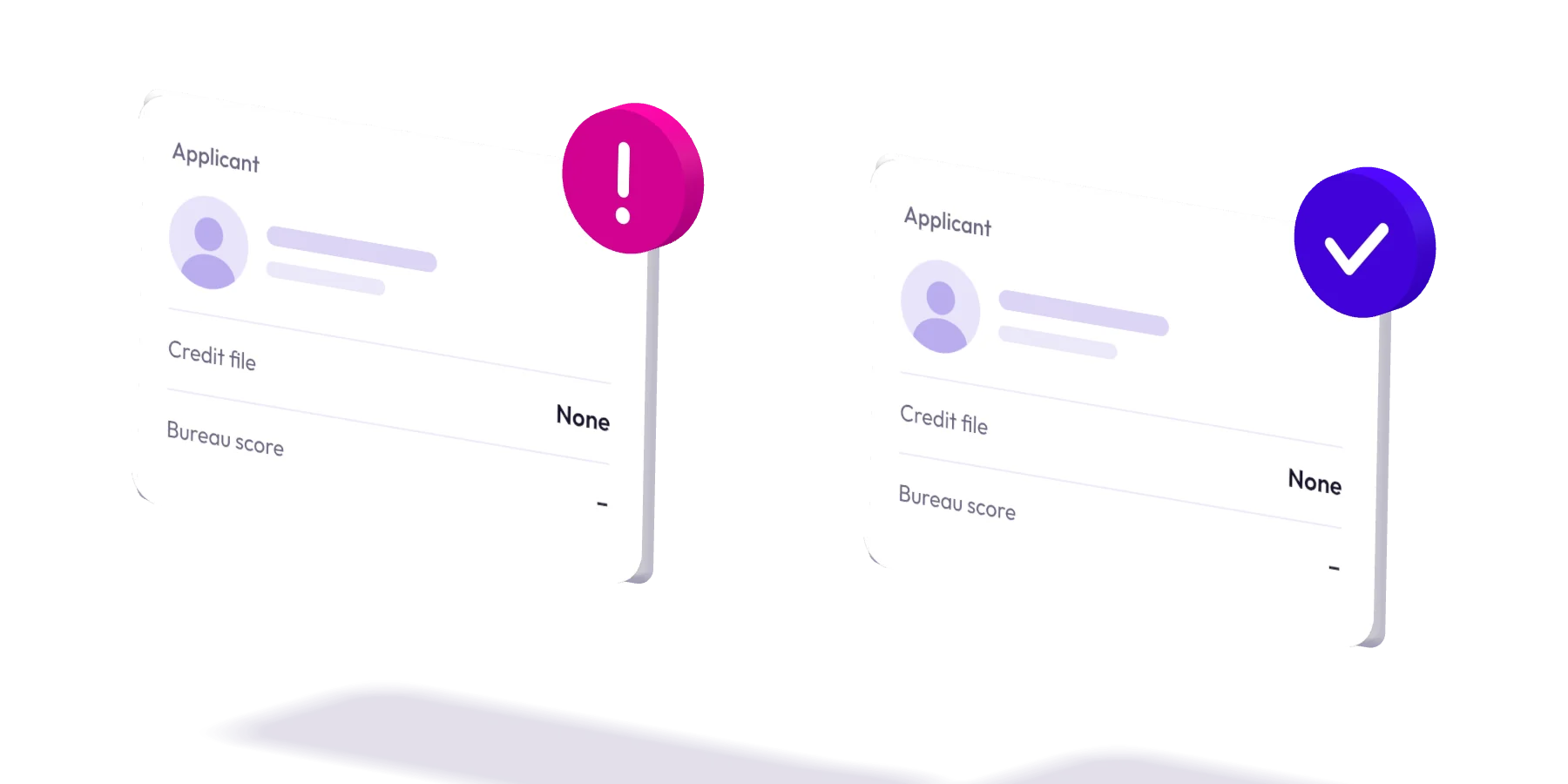
Split the problem and each side fails in its own way. A fraud team looking at a blank file sees risk everywhere, so genuine newcomers are rejected for being new. A credit team looking at the same blank file sees nothing, so a well-built fake can score like a real applicant with no history. One stack throws away good customers, the other lets bad ones through, and neither sees what the other knows.
Fraud team
Sees risk everywhere
Genuine newcomers are rejected for being new.
Credit team
Sees nothing
A well-built fake scores like a real applicant with no history.
The first failure is easy to miss because it never shows up as a loss. At the same bank, 3.6% of applicants had no legacy credit score yet passed every safety test, a group the bank would normally decline. They appear in nobody’s fraud numbers. They are simply revenue that never arrives.
The way out is evidence that serves both decisions. A real person’s footprint, a phone line held for years, an email with a history, services used across the web, is the best proof that they exist and also a signal of how they behave.
A fake can copy a document. It is far harder to copy years.
When it works, both numbers move at once
If fraud and credit really are one question, a single layer of identity evidence should improve both sides together. Two Monnai deployments show it:
| Deployment | Fraud side | Good-customer side |
|---|---|---|
| Ride-hailing app in emerging marketsSouth Asia and MEA | Fraud stopped at sign-up, from a phone number alone | 92% of riders and drivers approved instantly; up to 96% cleared for credit, with no credit history |
| Ride-hailing platform in South AsiaScored from a phone number alone | 96% of auto-rejected sign-ups were truly fraud | 93% of genuine traffic auto-approved; under 3% of genuine drivers rejected by mistake |
The ride-hailing app had to decide from a phone number alone: most riders and drivers have no credit history, few use email, and documents are hard to trust. One call gave it two answers, who to trust and who to lend to.
The ride-hailing result shows why. The strongest signal was messaging footprint: genuine drivers use their number everywhere, fake ones don’t. The same fact that catches the fraudster is the one that waves the real driver through.
Three changes worth making
- Put one identity layer under both decisions. The same signals should feed the fraud rule and the credit score, so the two teams stop working from different pictures of the same applicant.
- Stop treating “no credit file” as a risk. An empty file says nothing. The history and footprint behind the applicant say a lot.
- Measure the two together. Judge every control on fraud caught and good customers approved, on the same traffic. A control that improves one by sacrificing the other is moving the problem, not solving it.