Identity Verification (KYC)
Identity verification with nothing to upload
Is this person who they say they are? Check the details your customers type against official, mobile and consumer records, detail by detail.
Four products, one API call
Use one, or any mix, in the same call. Each answers detail by detail: match, partial match or no match.
How identity verification works
The details your customers already typed, checked against the records that hold them.
- 01
Send the details
The name, date of birth, ID number, phone or address the customer typed.
- 02
Each record answers
Match, partial match or no match, detail by detail.
- 03
See who is really there
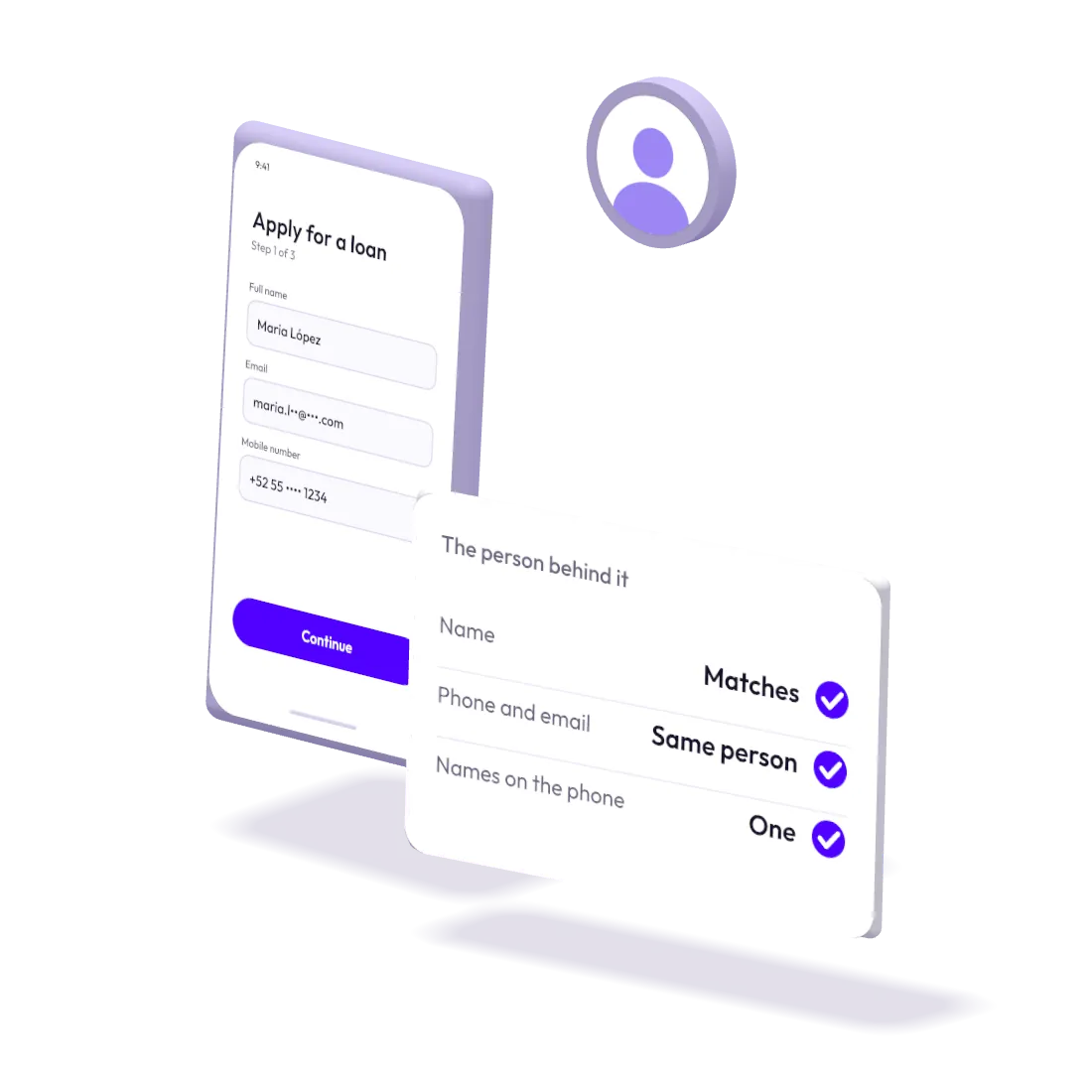
Add Consumer Risk Intelligence: stolen details match too.
Fewer good customers rejected for a typo
Real customers often fail KYC because of messy data, not fraud. Monnai cleans names and addresses before matching.
| Step | What happens | Example |
|---|---|---|
| Name cleansing | Removes titles and stray characters; handles accents, initials, double surnames and word order | “Ma. José García L.” matches “María José García López” |
| Address cleansing | Splits the address into street, number, city and postcode, and expands abbreviations | “Av. Paulista 1000, SP” matches “Avenida Paulista, 1000, São Paulo” |
| Part-by-part matching | Matches each part on its own: match, partial or no match | Street and city match, number differs: partial |
Get answers about Identity Verification
What is identity verification?
Identity verification confirms a person is who they say they are, the core of KYC (know your customer). Monnai checks the details your customers type against official, mobile and consumer records, detail by detail, with nothing to upload.
Which identity verification products does Monnai offer?
Four, through one API. Government KYC checks official records, Mobile KYC the mobile operator’s records, and Consumer KYC credit, utility and public records. Age Verification confirms a customer is old enough, without asking for an ID.
Why do real customers fail KYC checks?
Often because of messy data, not fraud: a missing accent, a shortened street name, two surnames in a different order. Monnai cleans names and addresses before matching, so fewer good customers are rejected for a typo.
Can stolen details pass identity verification?
They can pass a record check, because they belong to a real person. Mobile KYC catches them when the phone number is in someone else’s name, and Consumer Risk Intelligence shows who is really there: how the phone and email behave, and where they show up online.
Which countries does identity verification cover?
Identity checks go country by country, where the records exist. Government KYC covers 10 countries on four continents today; Mobile KYC, Consumer KYC and Age Verification depend on the records each country holds. Ask us about your markets.
Proof before you sign. Test Identity Verification on your own data.
A test on your own data in 5 business days, with results measured on production traffic.